

The Hidden Technology Behind High-Temperature Cables: E-Beam Cable Masterbatches
Most people think cable performance is determined by the polymer used in the insulation.
In reality, the real transformation often happens after extrusion.
It happens during Electron Beam (E-Beam) crosslinking.
And the key enabler behind that process is the E-Beam cable masterbatch.
What Is the Electron Beam (E-Beam) Process?
The Electron Beam (E-Beam) process modifies polymer molecular structure using high-energy electrons.
Instead of chemical curing systems like peroxides, the polymer chains are crosslinked through radiation, forming a stronger molecular network.
This process significantly improves the thermal, mechanical, and ageing performance of cable insulation and sheathing materials.
Because of this, E-Beam crosslinking is widely used in high-performance wire and cable applications worldwide.
Why Cable Manufacturers Use E-Beam Technology
Compared to conventional curing systems, the E-Beam process offers several performance advantages.
- Higher temperature endurance in demanding environments
- Improved fire performance after radiation exposure
- Stronger retention of mechanical properties over long service life
- Excellent resistance to UV ageing and environmental stress
- No peroxide curing agents and no curing ovens required
- Cleaner and more energy-efficient processing
The result is dimensionally stable cables that maintain insulation integrity under heat, stress, and electrical load.
The Role of E-Beam Cable Masterbatches
For radiation crosslinking to work efficiently, the polymer system must contain specific additives that promote controlled crosslinking under electron beam exposure.
This is where E-Beam cable masterbatches play a critical role.
These masterbatches contain specialised crosslinking promoters and stabilisers that enable:
- Consistent radiation crosslinking behaviour
- Controlled polymer network formation
- Stable extrusion and processing performance
- Reliable long-term cable performance
Without properly designed E-Beam masterbatches, radiation crosslinking can become inconsistent and unpredictable.
Applications of E-Beam Crosslinked Cables
Today, E-Beam crosslinked cable systems are used across industries where performance and reliability are critical.
Common applications include:
- Automotive wiring harness systems
- Industrial control cables
- Solar cable insulation systems
- Railway and transportation cables
- Heat-resistant tubing and polymer components
These applications require higher thermal ratings, longer service life, and improved electrical insulation performance.
Engineered E-Beam Cable Masterbatches from Takkar Polychem
At Takkar Polychem Pvt. Ltd., we develop specialised E-Beam cable masterbatches designed for reliable performance in radiation crosslinking systems.
Our formulations are engineered to support:
- Consistent dispersion of crosslinking promoters
- Stable extrusion behaviour during cable processing
- Predictable crosslinking performance under E-Beam radiation
- Improved thermal and ageing performance of the final cable
The goal is simple: deliver reliable masterbatch systems that enable cable manufacturers to consistently produce high-performance cables.
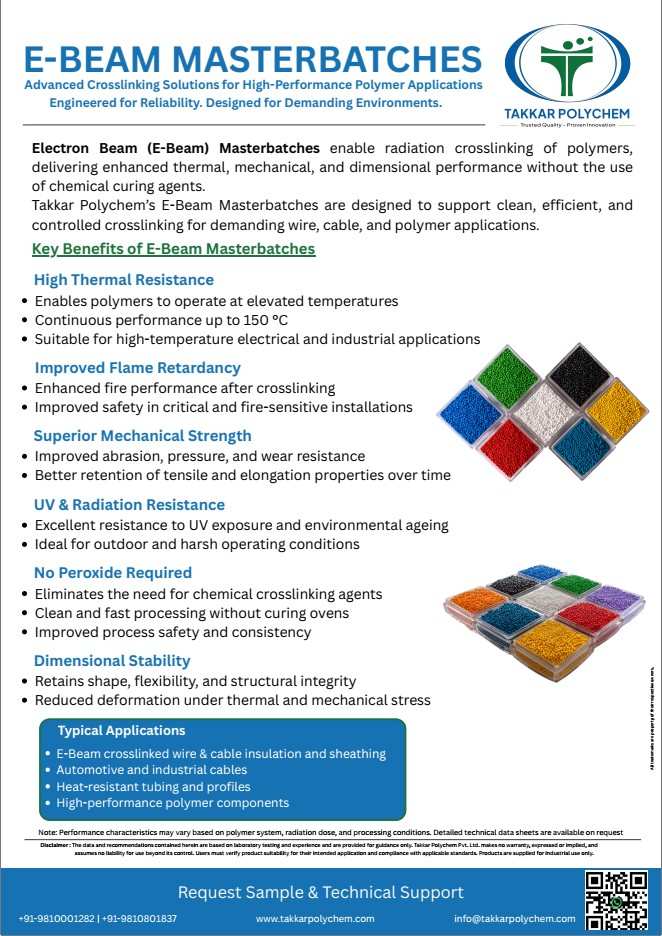
E-Beam Crosslinking: The Hidden Technology Behind High-Performance Cables
Leave a Reply
Your email address will not be published. Required fields are marked *